Clinical Significance of Prostate Volume
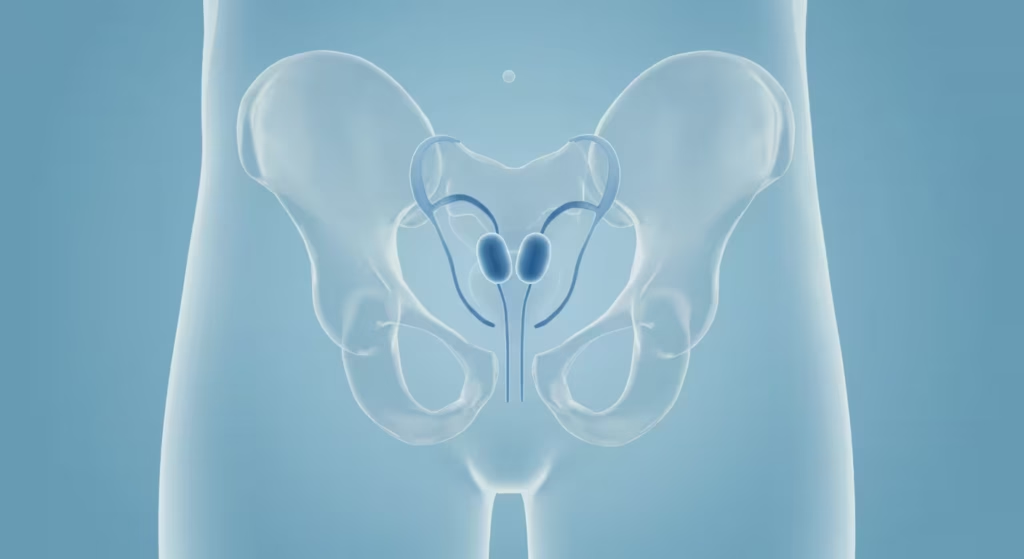
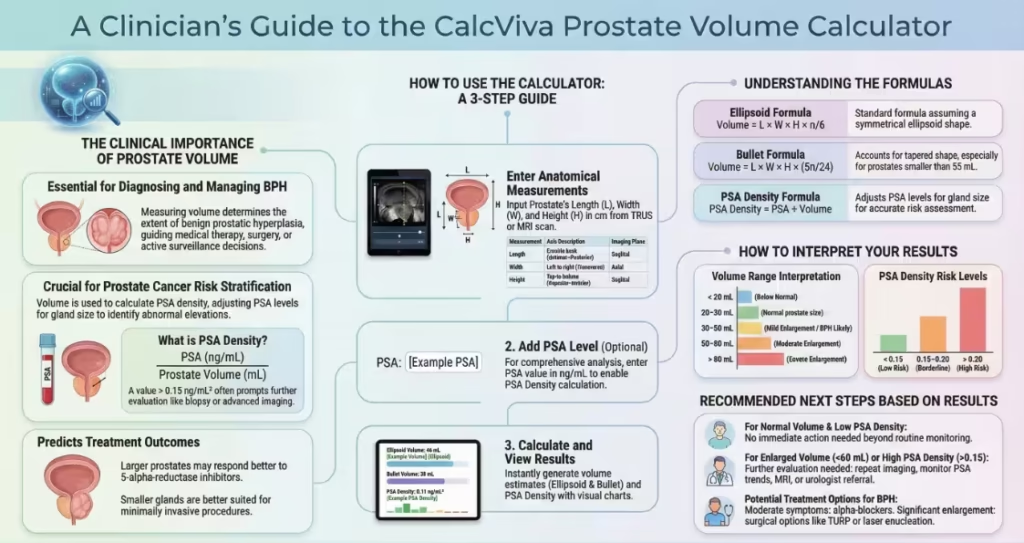
Prostate volume has a direct clinical impact on diagnosing, monitoring, and managing several urological diseases. An enlarged prostate, medically referred to as benign prostatic hyperplasia (BPH), is a common condition among aging men. Prostate volume measurement helps determine the extent of gland enlargement and guides decisions related to medical therapy, surgical intervention, or active surveillance.
Prostate volume also plays a pivotal role in prostate cancer detection. When interpreting Prostate-Specific Antigen (PSA) levels, volume is used to calculate PSA density, a crucial metric that adjusts PSA for gland size. For instance, a PSA level of 5.0 ng/mL may not indicate risk if the prostate volume is large, but could be concerning if the gland is small. Clinical thresholds like PSA density > 0.15 ng/mL² are often used to prompt biopsy or advanced imaging.
Additionally, accurate volume estimation helps predict treatment outcomes. Larger prostates may respond better to 5-alpha-reductase inhibitors, while smaller glands may be more suited for minimally invasive procedures. Thus, understanding and monitoring prostate volume is essential in delivering individualized care.
Step-by-Step Instructions
Using the CalcViva Prostate Volume Calculator is straightforward. It’s designed with a clean and responsive layout that guides users through each input field. Start by entering three critical anatomical measurements:
- Length (L): Anterior-posterior dimension
- Width (W): Transverse diameter
- Height (H): Superior-inferior dimension
All values should be entered in centimeters (cm) for consistency. There’s also an optional input field for PSA (Prostate-Specific Antigen) in ng/mL, which enhances the calculator’s utility by enabling PSA Density analysis.
Once all required values are inputted, click Calculate Volume to generate results instantly. You will see two volume estimates:
- Ellipsoid Volume
- Bullet Volume
Both are displayed visually using bar charts, along with clinical interpretations. Users can reset values using the Reset button or print the results via the Print Results option.
CalcViva ensures each output is meaningful with evidence-based recommendations to help users make informed healthcare decisions.
Measurement Guidelines
To use the calculator accurately, it’s essential to obtain reliable and standardized prostate dimensions. These measurements are typically acquired through Transrectal Ultrasound (TRUS) or Magnetic Resonance Imaging (MRI). Below are the guidelines for each dimension:
Measurement | Axis Description | Imaging Plane |
Length | Front to back (Anterior–Posterior) | Sagittal |
Width | Left to right (Transverse) | Axial |
Height | Top to bottom (Superior–Inferior) | Sagittal |
Always measure in centimeters (cm). Ensure the prostate is outlined properly on imaging before taking measurements. Accuracy is critical since small errors can lead to significant volume estimation discrepancies. Repeat measurements if image clarity is poor or if results seem inconsistent.
It’s advisable to take measurements when the bladder is moderately full, as over-distention can compress the prostate, altering results. Following proper imaging protocol is essential for clinical accuracy and meaningful interpretation using CalcViva’s calculator.
Volume Estimation Formulas Explained
Two well-recognized formulas are used in prostate volume estimation:
Ellipsoid Formula
Volume = L × W × H × π / 6
This is the standard formula in most clinical practices. It assumes the prostate is shaped like a symmetrical ellipsoid.
Bullet Formula
Volume = L × W × H × (5π / 24)
This formula accounts for the asymmetry and tapering seen in many prostates, especially smaller glands. It can offer better accuracy in prostates <55 mL.
PSA Density
PSA Density = PSA ÷ Volume
Used to adjust PSA levels for gland size. A PSA density >0.15 ng/mL² may warrant further urologic evaluation.
CalcViva uses both the ellipsoid and bullet models so clinicians can compare results and interpret them accordingly. Having access to both values helps make more nuanced clinical decisions.
How to Read Your PSAD Density Results
CalcViva displays three primary outputs:
- Ellipsoid Volume
- Bullet Volume
- PSA Density (if PSA is provided)
Each is expressed in milliliters (mL) or ng/mL². Here’s a simplified breakdown of how to interpret them:
Volume Range | Interpretation |
< 20 mL | Below normal – verify measurement or repeat test |
20–30 mL | Normal prostate size |
30–50 mL | Mild enlargement (BPH likely) |
50–80 mL | Moderate enlargement – monitor or treat |
> 80 mL | Severe enlargement – consider surgical options |
For PSA density:
- <0.15 → Low risk
- 0.15–0.20 → Borderline
- >0.20 → High risk of malignancy
These thresholds help guide urological referral, imaging, and biopsy decisions. CalcViva highlights each category with clinical messages to support medical interpretation.
What to Do Based on Your Prostate Gland Volume Results
If the calculator shows normal prostate volume and low PSA density, no immediate action is needed except routine monitoring. However, if volume is enlarged (especially >50 mL) and/or PSA density exceeds 0.15, further steps may include:
- Repeat imaging for confirmation
- PSA trend monitoring
- MRI of the prostate
- Referral to a urologist
- Consideration of biopsy if other risk factors are present
For patients with moderate urinary symptoms, treatment options such as alpha-blockers or 5-alpha-reductase inhibitors may be discussed. In cases of significant enlargement, surgical options like TURP, laser enucleation, or prostatic artery embolization may be considered.
CalcViva helps organize these next steps by showing actionable output, enabling early, informed clinical decisions.
Visual Chart Representation
CalcViva includes a dual-bar volume chart that displays:
- Ellipsoid Method volume
- Bullet Method volume
Each bar is dynamically scaled based on calculated volume. The longer the bar, the larger the estimated volume. This allows users to quickly grasp size comparisons and spot discrepancies between methods.
Bar labels show exact volume in mL, offering clarity in visual output. This is especially helpful in patient education, where complex numbers can be better understood with visual aids.
For example, if the bullet method shows a smaller value than the ellipsoid method, it may indicate a tapering shape of the prostate, a known finding in imaging. This added layer of interpretation improves clinical confidence.
Accuracy and Constraints of Testicular Volume Calculator
No tool is perfect, and even the best prostate volume calculators have limitations. The accuracy of this prostate gland volume calculator depends on:
- Precision of input measurements
- Image quality used for dimension extraction
- User entry errors
- Mathematical assumptions in volume formulas
The calculator assumes the prostate is symmetrical and properly visualized, which may not always be the case. Variability in gland shape, calcifications, or distortion from pathology may reduce accuracy.
CalcViva provides guidance only and is not a substitute for clinical judgment or advanced diagnostics. Users should always verify unexpected results with imaging review or repeat exams.
Important Disclaimer
This calculator is intended for educational and informational use only. It does not provide medical diagnosis, treatment recommendations, or act as a clinical decision-making psa density calculator on its own.
Always consult a licensed physician or urologist before making any healthcare decisions. Results from the CalcViva Prostate Volume Calculator are based on user-entered values and may vary depending on imaging quality, measurement accuracy, and formula assumptions.
By using this prostate psa calculator, you accept responsibility for its use and understand its limitations as an aid, not a diagnostic device.