

Understanding how to find the range of a data set is one of the first and most practical steps in learning statistics or data analysis. The range tells you how spread out your data is, even if your numbers are tightly packed together or scattered widely apart. Many students and analysts overlook this simple concept, yet it often gives a quick snapshot of data consistency and variability. Imagine checking daily temperatures, test scores, or product prices, the range helps you instantly see how much values differ. This article will walk you through each step of calculating the range, explain why it matters, and show how it fits with other measures like standard deviation and interquartile range. By the end, you’ll know how to compute, interpret, and apply the range confidently in any dataset.
Table of Contents
What Is the “Range” of a Data Set (in Statistics)?
In statistics, the range is a basic measure of how spread out a set of values is. It tells you the difference between the largest and smallest numbers in your data. The formula is simple:
Range=Maximum Value−Minimum Value
For example, if a data set has values {4, 7, 10, 2, 9}, the maximum is 10, and the minimum is 2, so the range equals 8. The larger the range, the greater the spread of values. A smaller range shows that your data points are close together. While the range doesn’t describe every detail of your dataset, it gives a quick idea of variability. It’s one of several measures of dispersion, alongside variance, interquartile range, and standard deviation. In real-world applications, the range helps you compare datasets, understand consistency, and spot possible outliers.
Why Should You Learn How to Find the Range of a Data Set?
Learning to find the range is valuable because it’s a quick, clear way to describe how much variation exists in data. Whether you’re studying student test scores, weather temperatures, or financial trends, the range helps you measure consistency. For example, if two classes have similar average scores but different ranges, the one with the smaller range has more consistent results. Businesses use the range to check how stable sales or expenses are over time, while scientists might use it to compare measurements across experiments.
However, while the range is easy to calculate, it doesn’t consider how data points are distributed between the highest and lowest values. A single extreme value, known as an outlier, can make the range appear larger than it truly represents. Still, understanding the range helps you recognize these issues early and encourages deeper analysis using other measures like the interquartile range (IQR) or standard deviation.
How Do You Find the Range (Step by Step)?
Finding the range involves a few simple but essential steps. Each step ensures you calculate accurately, even if your dataset is large or includes negative or decimal numbers. Let’s go through them clearly.
What Data Preparation Is Needed?
Before calculating the range, ensure your data is accurate and complete. Remove or handle any missing or incorrect values. If you’re using a large dataset, sort it in ascending or descending order to make identifying the minimum and maximum values easier. Sorting helps when you want to double-check that no hidden errors or duplicates affect the calculation. Clean data always leads to better results and fewer misinterpretations.
Which Values Are the Minimum and Maximum?
After preparing your data, identify the lowest (minimum) and highest (maximum) numbers. For instance, in the data set {3, 5, 8, 12, 7}, the minimum is 3, and the maximum is 12. It’s important to verify that no outliers distort your results. In a dataset like {1, 2, 2, 3, 100}, that “100” may drastically change the range, so understanding your data’s context matters.
| Example Data Set | Minimum Value | Maximum Value | Range |
| {4, 7, 10, 2, 9} | 2 | 10 | 8 |
| {-5, 0, 3, -2, 1} | -5 | 3 | 8 |
| {12.4, 14.6, 13.2, 12.1} | 12.1 | 14.6 | 2.5 |
How Do You Compute the Range?
Once you have the highest and lowest values, subtract the smallest from the largest. For example:
Range=10−2=8
If your dataset includes negative numbers, apply the same rule. For instance, in {-5.2, 0.3, 4.8, -1.1}, the maximum is 4.8, and the minimum is -5.2, giving a range of:
4.8−(−5.2)=10.0
This shows a total spread of 10 units. Always express your final range in the same units as your data (e.g., dollars, degrees, points).
How Do You Interpret the Result?
Interpreting the range depends on your context. A larger range means greater variability or inconsistency in your data, while a smaller range means your values are clustered closely together. For example, in exam results, a high range might suggest that some students performed very well while others struggled. However, because range depends on just two values, it’s easily affected by unusual or extreme data points. Therefore, while the range is useful for a quick overview, it should usually be followed by more detailed measures like variance or interquartile range for a fuller picture.
When Does the Range Fail or Mislead?
The range, although simple, has its weaknesses. It focuses only on the largest and smallest values, ignoring all other data points in between. This makes it highly sensitive to outliers. For example, in the set {10, 11, 12, 13, 100}, the range is 90, but four of the five values are close together. Here, a single extreme value creates a misleading picture of spread.
The range can also be zero, that happens when all the values are identical, such as {5, 5, 5, 5}. While technically correct, this result doesn’t reveal anything about variation because there isn’t any. For large or skewed datasets, the range doesn’t reflect true variability, and measures like the interquartile range (IQR) or standard deviation provide a better understanding. Still, the range remains useful for small data samples or when you need a fast way to describe variability before moving to deeper analysis.
What Alternative or Related Measures of Dispersion Should You Know?
While the range gives a basic sense of data spread, it doesn’t always tell the whole story. That’s where other measures of dispersion become useful. These include the interquartile range (IQR), variance, standard deviation, and coefficients of variation or range. Each of these tools provides deeper insight into how data points differ from each other and from the average. Unlike the range, which focuses only on the highest and lowest values, these measures take into account more of the data’s structure. Understanding them helps you interpret datasets more accurately and make better conclusions. Many statistical experts, including those at Statistics By Jim and Machine Learning Plus, emphasize combining multiple dispersion measures to get a balanced view of data consistency and reliability. Let’s take a closer look at how each measure works and when you should use it.
What Is the Interquartile Range (IQR)?
The interquartile range (IQR) is a measure that focuses on the middle 50% of your data. It’s calculated as the difference between the third quartile (Q3) and the first quartile (Q1):
IQR=Q3−Q1
This means it ignores extreme values, making it more reliable when your dataset contains outliers. For example, in exam scores {45, 48, 50, 52, 55, 90}, the high score of 90 would distort the range, but not the IQR. The IQR shows the spread of the central values, giving a better picture of overall consistency. Analysts often use the IQR in box plots to detect outliers and understand data concentration. It’s especially valuable in business, social science, and education studies where extreme results might otherwise mislead interpretations. Compared to the range, the IQR provides a cleaner, more stable measure of how typical data points vary.
What Is Variance / Standard Deviation?
Variance and standard deviation are two of the most important measures of dispersion in statistics. They show how much each data point differs from the mean (average) value. Variance is the average of squared deviations from the mean, while the standard deviation is the square root of variance. The formulas are:

These measures are essential because they account for all data points, not just the extremes. A small standard deviation means most values are close to the mean, while a large one indicates wide variation. For instance, two factories may produce bolts with the same average length, but the one with a smaller standard deviation has more consistent quality. Standard deviation is preferred in many fields, finance, manufacturing, science, because it reflects overall stability and predictability more accurately than range alone.
What Is Coefficient of Variation / Coefficient of Range?
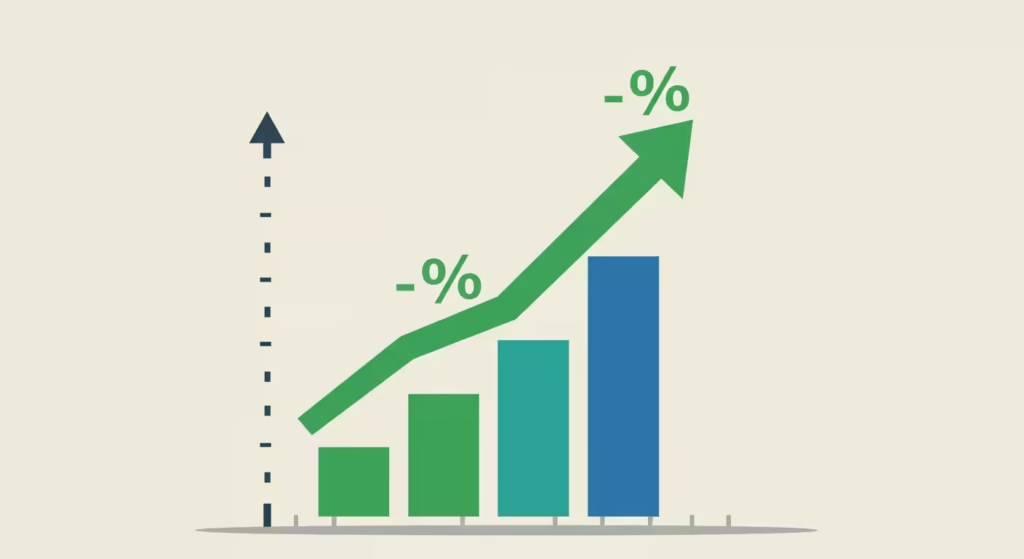
The coefficient of variation (CV) and coefficient of range (CR) express variability in relative terms rather than absolute numbers. The CV compares the standard deviation to the mean, often shown as a percentage:This ratio shows dispersion without depending on the scale of measurement. These coefficients are especially valuable for comparative analysis in economics, biology, and quality control, helping to normalize data spreads across different scales. Both measures complement the traditional range by adding context about relative consistency.
Which Measure to Use When?
Choosing the right measure of dispersion depends on your data type, distribution, and presence of outliers. If your dataset is small and free of outliers, the range is simple and effective. For datasets with outliers, the IQR gives a more accurate view of central spread. When precision is crucial, such as in finance or experimental research, standard deviation is the most informative because it reflects every data point. For comparing different datasets or evaluating consistency in proportional terms, the coefficient of variation works best. Experts like Statistics By Jim and Machine Learning Plus recommend using multiple dispersion measures together to gain a comprehensive understanding of variability. In summary, no single measure is perfect; the choice should always depend on the nature and goal of your analysis.
Can You Find the Range in Grouped / Frequency Data?
Yes, you can calculate the range for grouped data, though it involves a slightly different process. Grouped or frequency data represents values arranged in class intervals (for example, 0–10, 10–20, 20–30), along with how many observations fall into each range. This format is used when datasets are large, making it impractical to list every value individually. To find the range, subtract the lower limit of the first class from the upper limit of the last class.
How Is Grouped Data Different from Raw / Ungrouped Data?
In raw or ungrouped data, every data point is shown separately. In grouped data, values are organized into intervals that summarize the frequency of occurrences. Grouping simplifies large datasets but also reduces precision because you lose the exact values of each point. For instance, if you have student scores grouped as 0–10, 10–20, and 20–30, you don’t know the exact score of each student, just the range in which it falls.
How Do You Find Range with a Frequency Distribution / Class Intervals?
To calculate the range in grouped data:
- Identify the lowest class limit and highest class limit.
- Subtract the lowest limit from the highest limit.
- The result gives the approximate range.
Example:
| Class Interval | Frequency |
| 0 – 10 | 4 |
| 10 – 20 | 6 |
| 20 – 30 | 8 |
| 30 – 40 | 2 |
Here, the lowest limit is 0 and the highest limit is 40.
Range=40−0=40
Limitations / Approximations
When using grouped data, the range is an estimate, not an exact measure. Because class intervals group several values together, small variations inside each class are ignored. This method works well for summarizing data, but detailed measures like standard deviation or variance give more precise results when exact values are available.
What Are Some Practice Problems (with Solutions)?
Let’s reinforce what you’ve learned with practical examples. Try solving these before checking the solutions.
Problem 1
Find the range for this data set: {5, 8, 12, 15, 9, 10}
Solution:
Maximum = 15, Minimum = 5
Range = 15 – 5 = 10
Problem 2
Data set: {-3.5, -1.0, 0.5, 2.5, 4.0}
Solution:
Maximum = 4.0, Minimum = -3.5
Range = 4.0 – (-3.5) = 7.5
Problem 3
Grouped data example:
| Class Interval | Frequency |
| 10 – 20 | 5 |
| 20 – 30 | 7 |
| 30 – 40 | 3 |
Range = 40 – 10 = 30
These examples show that the range works for both positive and negative numbers, as well as grouped data. It’s simple yet effective for quick comparisons.
How Do You Present the Range Visually?
Visualizing the range helps you understand and communicate data spread more easily. In a box plot (or box-and-whisker plot), the total length of the plot’s “whiskers” represents the range, while the box itself shows the IQR. This format quickly reveals how data is distributed and where the outliers lie.
In histograms or dot plots, you can mark the minimum and maximum values to display the range directly on the chart. For example, a histogram of sales figures could highlight the lowest and highest values with vertical lines, giving a quick view of variation.
In exploratory data analysis, plotting ranges across different variables helps analysts compare consistency between datasets. A simple range plot can show which category or time period has the greatest fluctuation. Visual tools make interpretation faster and help reveal trends that might not be obvious from numbers alone.
How to Conclude and What to Do Next
Understanding how to find the range of a data set is one of the most important early steps in mastering data analysis and statistics. The range provides a quick look at how much your data varies, highlighting whether your values are close together or spread far apart. By learning this, you’ve also discovered related measures such as the interquartile range (IQR), variance, and standard deviation, each offering a more detailed understanding of data dispersion. While the range is simple and fast to calculate, it should be used alongside other tools for deeper accuracy, especially when your data includes outliers or skewed distributions.
If you’re just beginning your study of statistics, your next step should be to explore topics like IQR vs range, variance and standard deviation formulas, and how to interpret variability in different data types. Practicing with both raw and grouped data will strengthen your analytical skills. Remember, statistical understanding grows from combining simplicity with precision, and the range is the perfect place to start that journey.
For more insight, consider exploring trusted resources such as Statistics By Jim, Machine Learning Plus, and educational platforms that focus on data interpretation and descriptive statistics. These can help you apply your knowledge to real-world problems and develop stronger data literacy for research, business, or academic success.